



BLOGS
Industrial Spill Cleanup Products: The Smart Buyer’s Guide to Safer, Lower-Cost Cleanup
Industrial spills are not rare emergencies. They are routine operational events in maintenance bays, fleet yards, warehouses, loading docks, farms, manufacturing plants, and retail service centers. A leaking hydraulic line, a tipped fuel container, a cracked coolant hose, or a loose drum fitting can put oil or chemicals on concrete in seconds.
What separates a controlled situation from a costly problem is not luck. It is preparation and product selection.
This guide is built for decision makers who want to choose industrial spill cleanup products intelligently. It explains how to reduce labor time, minimize disposal volume, improve safety, and avoid wasting money on the wrong materials. If you manage a facility, oversee safety compliance, or control purchasing, this is the strategic framework you should be using.
Why Industrial Spill Cleanup Is Often More Expensive Than It Needs to Be
Many facilities overpay for spill response without realizing it. The most common causes are:
Using universal absorbent for every type of spill
Dumping excessive granular absorbent instead of containing first
Throwing away reusable containment products after one use
Ignoring material performance differences
Buying based on habit instead of performance
Spill cleanup cost is not just the price per bag or per spill kit. It includes:
Labor time
Disposal fees
Downtime
Slip and fall risk
Environmental compliance exposure
When industrial spill cleanup products are selected strategically, these hidden costs drop significantly.
Step One: Understand the Type of Spill You Are Dealing With
Before selecting any absorbent, identify the fluid. This single decision changes everything.
Hydrocarbon Spills
These include oil, diesel, gasoline, hydraulic fluid, and lubricants. They require oil absorbent materials that attract hydrocarbons. Hydrophobic and oleophilic materials perform best because they repel water while pulling in oil.
Mixed Fluid Spills
Coolants, cutting fluids, and shop floor mixtures often contain both oil and water. Some universal absorbents will work, but performance varies widely depending on material type.
Chemical and Acid Spills
Corrosive chemicals require a specific response. An acid spill clean up kit typically includes neutralizers and compatible absorbents. Using the wrong material can create additional hazards.
Large Volume Spills
Tank failures or major equipment leaks demand immediate containment. This is where boom socks and perimeter control become critical.
Understanding the fluid narrows your product selection immediately and prevents overuse of the wrong material.
The Containment First Principle
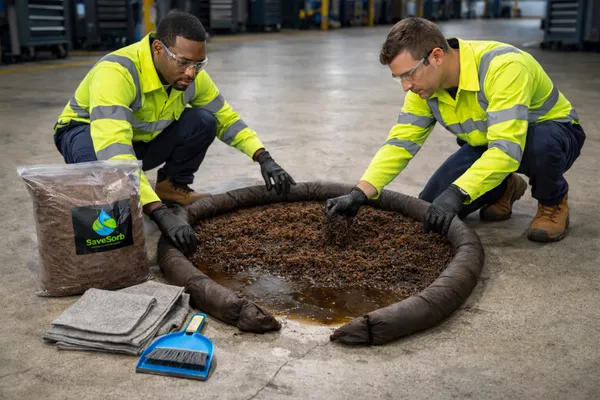
One of the biggest mistakes in industrial spill cleanup is pouring granular absorbent directly onto a spreading spill.
Professionals contain first.
Absorbent socks or boom socks are placed around the perimeter to stop movement. Their job is control. They prevent oil from migrating across floors, reaching drains, or spreading downhill.
Once the spill is contained, granular absorbent is applied inside the controlled area to remove liquid from the surface.
This approach:
Reduces total absorbent used
Prevents expansion of the contaminated zone
Shortens cleanup time
Improves safety
Containment prevents escalation. Granular absorbent completes the cleanup.
Granular Absorbent Versus Boom Socks: Different Tools for Different Jobs
These tools are not interchangeable.
When to Deploy Boom Socks
Active leaks
Sloped surfaces
Outdoor areas near storm drains
Fuel islands
Large spreading spills
Boom socks are about stopping movement. They buy you time and protect surrounding areas.
When to Use Granular Absorbent
Stationary spills
Final surface cleanup
Pulling fluid from textured concrete
Removing residual slip hazards
Granular absorbent works best when applied deliberately inside a controlled area. It interacts directly with the fluid, encapsulating it and allowing safe removal.
The most effective industrial spill cleanup products strategy uses both.
Why Material Choice Matters More Than Brand Familiarity
Buyers often focus on brand recognition instead of material performance. That approach increases long term cost.
Clay based absorbent products are heavy and absorb everything, including water. They often require high application volume and increase disposal weight.
Synthetic universal absorbents are lightweight and convenient, but they typically become saturated quickly and are frequently single use.
Plant based granular absorbent, including peat moss oil absorbent, attracts hydrocarbons while resisting water. Lightweight natural fibers encapsulate oil within their structure rather than leaving it pooled on the surface.
This performance difference directly impacts:
Quantity required
Speed of absorption
Disposal volume
Environmental handling
Material choice affects total cost more than price per bag.
Reusability Changes the Economics of Spill Response
High quality absorbent socks, pillows, and Spillow mats can be reused multiple times until fully saturated. Their job is not single event disposal. They are designed for repeated containment and absorption.
Additionally, plant based fibers that do not come into contact with hazmat remain clean and reusable. If part of the granular absorbent applied never touches the spill, that material does not need to be discarded.
This reduces:
Product consumption
Disposal frequency
Inventory turnover
Long term operating cost
When evaluating industrial spill cleanup products, always factor in reusability.
A Practical Five Question Decision Framework
When a spill occurs, use this structured approach:
What is the fluid
Is it actively spreading
How large is the spill
Is the surface porous
Is water present
Stop the source.
Contain with boom socks.
Apply granular absorbent inside the perimeter.
Remove only saturated material.
Return clean containment products to service when safe.
This method reduces waste and improves consistency.
Final Thoughts: Smarter Buyers Win
Industrial spill cleanup products are not commodities. They are operational tools.
The smartest buyers evaluate:
Material performance
Reusability
Disposal volume
Labor efficiency
Safety impact
Contain first. Absorb second. Reuse when safe. Dispose only what is saturated.
That is how professional facilities protect workers, reduce costs, and maintain clean, compliant operations.
If you are ready to upgrade your spill management system, explore the full line of SaveSorb granular absorbent, reusable containment socks, pillows, Spillow mats, and spill kits at:
Smarter cleanup starts before the spill happens.

Subscribe to News & Offers
Be the first to know about new products and exclusive offers.
Search I FAQ I Returns I Privacy Policy I Terms of Use


© 2025, SaveSorb LLC Powered by Shopify