



BLOGS
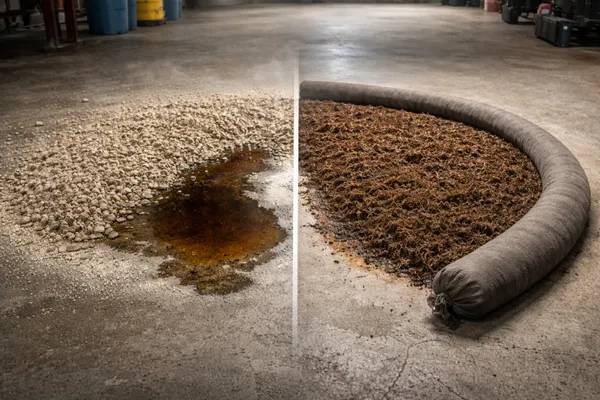
Peat Moss Oil Absorbent vs Oil Dry: Which Cleans Oil Better in Real-World Conditions?
When buyers search peat moss oil absorbent vs oil dry, they are not looking for marketing language. They are looking for performance. They want to know which material actually works better on concrete floors, shop bays, loading docks, and fleet yards.
Oil spills are not theoretical problems. They create slip hazards, increase fire risk, slow down operations, and add disposal costs. For fleet managers, shop owners, and industrial buyers, the right granular absorbent for oil spills directly affects safety and operating margins.
This guide compares peat moss oil absorbent and traditional clay oil dry absorbent across the performance factors that matter most in the real world.
The Real Question: What Does “Cleans Better” Actually Mean?
Cleaning oil from concrete is not just about soaking up visible liquid.
True cleanup performance includes:
How quickly the material absorbs oil
Whether the surface is left safe and dry
How much labor is required
How much dust is created
How heavy and expensive the waste becomes
Whether components can be reused
The material that performs best across all of these areas is the one that truly cleans better.
Absorption Speed: How Fast Does It Stop the Spread?
In active work environments, speed matters.
Clay oil dry absorbent works by covering the spill and slowly drawing oil into porous mineral granules. It typically requires heavier application and aggressive sweeping to help the material work into the liquid. During that process, oil can continue to spread outward if not contained.
Peat moss oil absorbent tends to begin binding oil immediately on contact. The material visibly darkens as it absorbs. Less product is often required to stop movement. The spill perimeter stabilizes faster, reducing the chance of migration toward drains, equipment, or walkways.
In a busy maintenance bay, every minute a spill remains active increases risk. Faster absorption reduces hazard exposure and gets crews back to work more quickly.
From a practical standpoint, the material that controls spread fastest reduces secondary damage and labor escalation.
Surface Finish and Slip Reduction
Absorbing oil is one step. Leaving the surface safe is another.
Clay oil dry absorbent often leaves a fine powder behind after sweeping. Even when the visible oil is removed, small residual particles can remain embedded in textured concrete. That can create a lightly slick or dusty surface that requires additional scrubbing.
Peat moss based granular absorbent for oil spills typically leaves a drier, more matte finish. Because oil is drawn into fibrous organic material rather than loosely coated on mineral granules, the remaining surface often restores traction more effectively.
Slip reduction is not a minor detail. Workplace falls are expensive. Even a small improvement in traction after cleanup can reduce injury risk.
A material that leaves the floor genuinely dry and safer underfoot delivers measurable operational value.
Labor Time Required: The Hidden Cost Driver
Many purchasing decisions focus on bag price. That is a mistake.
Labor is often the largest component of spill cleanup cost.
With clay absorbents, crews frequently need to:
Apply a thick layer
Allow dwell time
Grind the material into the spill with brooms
Sweep multiple times
Repeat the process for stained areas
This requires time and physical effort. On larger spills, labor hours increase quickly.
Peat moss oil absorbent generally requires less aggressive mechanical effort. It can be applied in a controlled layer, allowed to work, and then swept up with fewer passes.
When evaluating peat moss oil absorbent vs oil dry, the difference in labor time over a year of routine spills can exceed the difference in material cost.
Faster cleanup cycles mean:
Less downtime
Lower payroll allocation to cleanup tasks
More productive labor hours
Performance impacts labor cost, not just material cost.
Dust and Air Quality in Enclosed Spaces
Dust is often overlooked in spill cleanup discussions.
Clay oil dry absorbent can produce airborne dust during pouring and sweeping. In enclosed garages and fleet maintenance facilities, that dust lingers in the air and settles on tools and equipment.
Repeated exposure to dusty conditions is not ideal for workers. It also increases housekeeping workload.
Peat moss oil absorbent typically produces significantly less airborne dust when handled properly. This contributes to:
Cleaner shop environments
Less residue on equipment
Improved air quality
For industrial buyers concerned about worker comfort and regulatory compliance, reduced dust generation is a meaningful performance advantage.
Disposal Weight and Waste Volume
What happens after the spill is cleaned is just as important as the cleanup itself.
Clay is heavy. When saturated with oil, it becomes heavier. Every pound applied to the spill becomes disposal weight. Because clay absorbents are generally treated as single use materials, all applied product enters the waste stream.
That increases:
Dumpster volume
Waste hauling frequency
Landfill fees
Peat moss oil absorbent is significantly lighter by comparison. Because it absorbs efficiently, less total volume may be required to achieve effective cleanup. Lower weight reduces disposal costs and makes handling easier for workers.
Clay absorbents are single use and increase disposal weight. Over time, that weight difference translates into real dollars.
For operations managing frequent fluid leaks, annual disposal cost differences can become substantial.
Reusability and Cost Efficiency
Reusability is where the performance gap becomes financially significant.
Absorbent socks, pillows, and Spillow mats made from plant based materials are reusable multiple times until fully saturated. Their primary role is containment. They stop spread and protect drains. Once deployed, they can often be repositioned and reused for subsequent spills until they reach full saturation.
That means one containment component can serve multiple incidents before replacement is required.
In addition, plant based granular fibers that do not come into contact with hazmat remain clean and reusable. If excess material is applied around the perimeter of a spill but does not absorb contamination, it does not automatically become waste.
This is a major distinction.
Clay absorbents do not offer this flexibility. Once poured and used in a spill area, the material is generally swept up and discarded. It is not considered reusable.
Reusability directly affects:
Purchase frequency
Inventory turnover
Waste generation
Long term operating cost
Cost efficiency is not determined by bag price alone. It is determined by how many cleanup cycles a product supports.
Real World Scenario: Fleet Maintenance Bay
Consider a fleet maintenance facility handling daily hydraulic leaks and fuel drips.
With clay oil dry absorbent:
Heavy product is applied repeatedly
Dust accumulates
Multiple sweep cycles are required
Waste bins fill quickly
Replacement orders are frequent
With peat moss oil absorbent:
Smaller volumes stabilize spills
Surface traction is restored faster
Less dust circulates
Waste weight is reduced
Containment socks and pillows are reused until saturated
Multiply those differences across hundreds of minor incidents per year. The operational gap becomes clear.
Spill Kits and Material Selection
When assembling oil spill cleanup products for trucks, service vehicles, or facilities, material selection inside the spill kit absorbent material category matters.
A well designed spill kit should include:
Containment socks or booms
Absorbent pillows
Granular absorbent for oil spills
Protective gloves
Disposal bags
Choosing peat moss oil absorbent as the granular component and plant based reusable containment products changes the cost structure of the entire kit.
Industrial buyers evaluating spill kit performance should consider:
How often components must be replaced
How much waste is generated per incident
How quickly a spill can be stabilized
How safely the surface is restored
The best performing spill kit is not the cheapest upfront. It is the one that reduces total cost over time.
Environmental and Operational Responsibility
Modern operations face increasing pressure to reduce waste and operate responsibly.
Lower disposal volume supports sustainability goals. Lighter waste reduces transport impact. Reusable containment products reduce material consumption.
Peat moss oil absorbent aligns with operational efficiency while supporting responsible waste management practices.
For organizations seeking improved environmental performance without sacrificing cleanup effectiveness, material choice becomes strategic.
Evaluating Total Cost of Ownership
When comparing peat moss oil absorbent vs oil dry, a total cost approach should include:
Material purchase price
Labor time per spill
Surface restoration effort
Dust management and housekeeping
Disposal weight and hauling fees
Reusable component lifespan
Clay oil dry absorbent may appear economical per bag. However, if it requires more product, more labor, and generates more waste, its annual cost may exceed alternatives.
Peat moss oil absorbent often delivers savings through efficiency rather than sticker price.
Fleet managers and procurement teams should analyze spill frequency, average volume per incident, and labor allocation. A short internal audit often reveals where real costs accumulate.
Making the Shift
Transitioning from clay to peat moss oil absorbent does not require operational overhaul.
It requires:
Educating crews on proper application
Measuring product usage per incident
Tracking labor time
Monitoring disposal weight
Within weeks, performance differences become visible.
For organizations evaluating alternatives, testing both materials side by side on similar spill types provides immediate clarity.
Why Material Choice Matters More Than Habit
Clay has been used for decades. Familiarity drives continued use in many facilities.
But habit is not a performance metric.
Material science and operational demands have evolved. Facilities are faster paced. Labor costs are higher. Waste fees continue to increase. Safety standards are stricter.
Choosing the right granular absorbent for oil spills is no longer a simple supply decision. It is an operational efficiency decision.
Final Verdict: Which Cleans Oil Better?
If cleaning better means:
Faster absorption
Safer surface finish
Reduced labor time
Lower dust generation
Reduced disposal weight
Reusable containment components
Then peat moss oil absorbent consistently demonstrates performance advantages in real world environments.
Clay oil dry absorbent remains a functional but basic solution. It absorbs oil. However, it often demands more labor and generates more waste.
For fleet operators, industrial facilities, and shop managers focused on safety and total cost control, performance across the full cleanup cycle matters more than tradition.
Material choice affects more than a single spill. It influences annual operating cost, worker safety, and environmental footprint.
If you are currently evaluating oil spill cleanup products or reassessing your spill kit absorbent material, it may be time to compare results directly.
To explore plant based spill cleanup solutions designed for real world performance, visit https://savesorb.com/ and review available options.
Before placing your next absorbent order, take a closer look at what your current material is truly costing you in labor, waste, and long term efficiency.

Subscribe to News & Offers
Be the first to know about new products and exclusive offers.
Search | FAQ | Returns | Privacy Policy | Terms of Use


© 2025, SaveSorb LLC